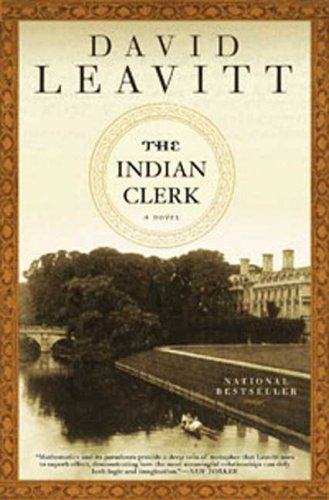
 Meredith loaned me this book when I ran out of things to read on the Google Shuttle. The author's brother is a friend of theirs, whose wedding they had recently attended.
The title character is Srinivasa Ramanujan, a visionary Indian mathematician who came to Cambridge, just before World War I, from Madras, where he had been working as a clerk. However, the main character of the narrative is G. H. Hardy, the eminent Cambridge mathematician to whom Ramanujan wrote, and who worked closely with him during his time in England.
Hardy makes an interesting character, and the book is largely about his relationship with Ramanujan, but it is even more about life at Cambridge and in England before and during the war. Many important historical figures make their appearances, including Bertrand Russell—another mathematician, but also a vehement pacifist—, D. H. Lawrence, and, very peripherally, Virginia Woolf.
Leavitt portrays the human side of Hardy, pushing his own mathematical brilliance into a largely secondary role. Chief among the traits are his constant wordplay, his interest in cricket, his own pacifism, and his homosexuality. This last receives a great deal of emphasis. While homosexual acts are portrayed as very much commonplace in the Cambridge of the time, most of the men ultimately leave the behavior behind and marry (women). Hardy never married.
We have a tendency, I think, to treat mathematicians in the cold, objective manner of mathematics, almost as objects themselves, to which we assign a sequence of results. Leavitt successfully renders the humanity of the mathematicians in this book. On the other hand, a fair amount of the story is fiction, and I'm not sure it's not too much.
Saturday, November 8, 2008
The Indian Clerk by David Leavitt

Subscribe to:
Post Comments (Atom)
0 comments:
Post a Comment