. . . Mathematical Recreations from Scientific American Magazine
Meredith gave me this book a number of years ago. Far enough in the past that I don't have a record of when I got it. I started reading it at one point, but as it is a collection of mostly distinct, unrelated columns from Scientific American, it was easy to stop between chapters.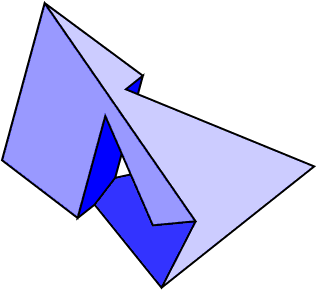 The columns repeated in this book frequently present a dilemma—it's hard to think and read at the same time. On the one hand, it is often entertaining and rewarding to consider the puzzles presented in the columns. I spent most of one evening constructing a paper model of the Szilassi toroidal polyhedron pictured at right and featured in chapter 8, "Minimal Sculpture". On the other hand, there is often some resistance from the part of my brain that just wants to relax and absorb information.
I think this reading I spent enough time thinking that at least the more interesting chapters will stick with me. Last time they didn't—I remembered so little from the chapters that I had already read that I decided to start over from the beginning, canceling all of the advantage of reading books with bookmarks in them.
One of the later chapters is a review of Douglas Hofstadter's Gödel, Escher, Bach. It begins with the immensely intriguing sentence, Every few decades an unknown author brings out a book of such depth, clarity, range, wit, beauty and originality that it is recognized at once as a major literary event.
When I read this, I was momentarily excited by the prospect of reading a list of examples. But the only detail supplied to specify this curious generalization is that Gödel, Escher, Bach is such a book. That was a tremendous disappointment.
If such a book does in fact come along so frequently, there should be several examples from the Twentieth Century and maybe even one more recent than GEB. Does anyone wish to nominate any candidates?
Sunday, February 10, 2008
Fractal Music, Hypercards and More . . . by Martin Gardner

Subscribe to:
Post Comments (Atom)
6 comments:
Have you read GEB? If anyone wants to, I have a copy. I have to say that the book had so much depth and range that I couldn't appreciate the clarity, wit and beauty.
I read it in 1999. I also have a copy. It is definitely full of complex ideas recruited from a wide swath of thinking.
I think that's a pretty cliché sentence that I swear I've already read in numerous reviews and critical articles ... I wouldn't trust anybody who wrote it! And I hope I never find myself writing it!!
I nominate Joyce Carol Oates's "Bellefleur".
If lots of people have written approximately the same sentence in reviews of several different books, doesn't that mean it's true?
Was JCO an "unknown author" when Bellefleur was published?
unknown to whom?
Hmm, I don't know. Good point.
Post a Comment