You may accuse me of exaggerating little-known history, but I will maintain that there is a very real sense in which Nothing But Tromble was born out of a Joyce Carol Oates discussion group that never existed.
About two years ago, I, among other Trombles, was reading Oates' Bellefleur as a prelude to Tanya's thesis on the topic. I was curious about the recurrence of Anubis in the book and corresponded with Tanya about it. She suggested including Mom and Kris in the conversation, because they were reading as well. Unfortunately, the means of doing so were somewhat inadequate. This may have been the very first inkling I experienced of an idea that would grow into a family blog.
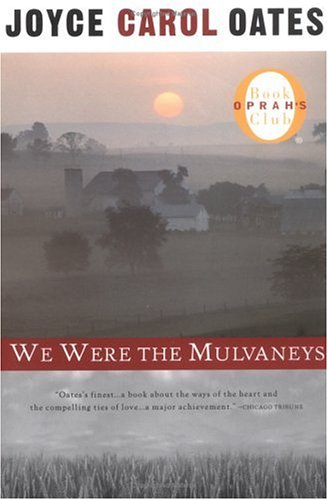 Because of this history, I feel not only justified but compelled to introduce a discussion of another Oates book that I finished reading just yesterday—We Were the Mulvaneys. I know at least a couple others have read it. And I would like to pose the following question:
A blurb on the back of my copy from the L.A. Times Book Review claims the book "Will break your heart, heal it, then break it again." At what point was my heart supposed to have healed enough to be rebroken?
Friday, September 23, 2005
We were a book group

Subscribe to:
Post Comments (Atom)
9 comments:
Uh... did yours break in the first place?
Dad
That's what I was wondering.
It's been too long since I've read that one to remember what heart breaking/mending may have occured. I just finished the biography of Oates as well as her novel for the juvenile set, Freaky Greens Eyes. I have a hold on a new book, Missing Mom, that the library has on order. Seems like that'll be the 5th book or so by her I've read this year--it's hard to keep up with the output! Though I think I've read all or all but one of the novel & story collections listed in her bibliography. Some but not all of the plays, and definitely not all the essays, criticisms & other stuff.
First of all, no comments from the peanut gallery. Meaning those who haven't read the book which I'm sure Evan hasn't and am willing to bet Dad hasn't either!
I don't really know how to answer your question, Roy, except to say that I never pay any attention to those book cover quotes. I also have a quote on my front cover from the Chicago Tribune saying that it's "Oates's finest" which I didn't really think when I read it. It has been a few year though. Putting aside the fact that it's an Oates book for a minute, what did you think of it just as a novel?
I must say I'm quite proud of once again being accredited with sparking the idea for the blog!
I wouldn't normally put any stock in out-of-context quotes either. In this case, though, I read it before opening the book, and it seemed such a clear statement of the plot's trajectory.
I think perhaps the moment in question was the bog scene. Anyone remember that? I found it somewhat ambiguous at first, and that may have mitigated the positive it would otherwise have engendered.
The foreshadowing before the scene leads one to expect a more problematic outcome. There's something weird about it, too. It resolves everything for Patrick, but nothing for anybody else, including, to a large extent, the reader. At least, in my case.
Overall, I enjoyed the book. But, the ending fell a little flat.
Endings are hard. It's rare that I actually really like an ending. I always feel I'm being jipped out of something. When you say "flat", do you mean that the normalcy of the end scene is in stark contrast to everything else that has happened in the book? It's interesting that you signal out the bog scene. I wouldn't have thought of that. Do you think that's supposed to be the healing portion refered to in the quote?
I've thought myself in circles trying to sort it out. I was less content with the second half or so of the book—not the end scene—than the first. Possible correlates are the narrator's perspective (less omniscient, I think) and the distance between events (increasingly far apart).
I'm not as sure about the bog scene as I was yesterday.
Interesting. The differences in perspective and distance between events is very Oates-like. She does this often in what she terms her "family sagas". As the children grow up you get more distanced from the original events and more space between events since she usually deals with all the children and they aren't living together anymore. You should read her novel "The Falls" that came out late last year. It's written in a similar family saga way. It might be interesting if you have something else of hers to compare Mulvaneys to.
Post a Comment